
Is Warsaw Worth Visiting? An Honest Local Guide (2026)
Is Warsaw worth visiting? Our local guides say: absolutely. Here's what makes Warsaw unmissable – and what honestly won't blow you away. Updated for 2026.
Karolina K.
3/4/20268 min read
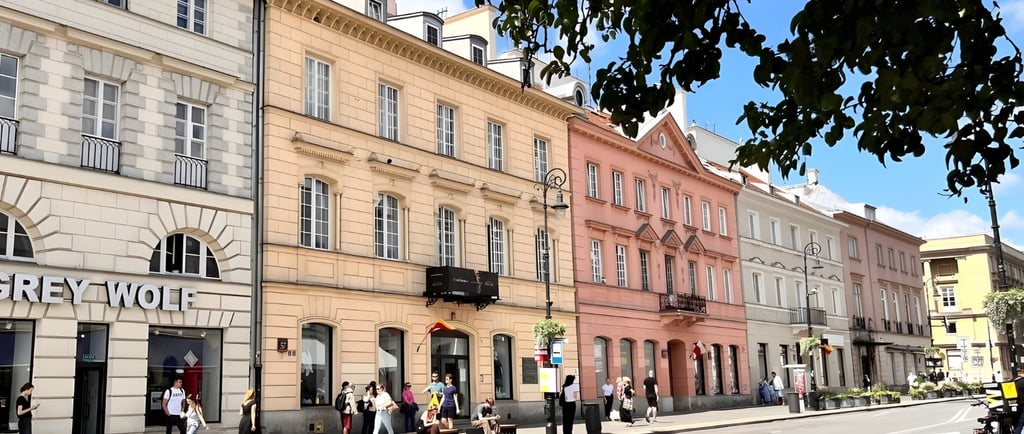
Warsaw is one of the most underestimated capitals in Europe. Ask most travellers about Poland and they'll mention Kraków – its medieval beauty, the Wawel Castle, the proximity to Auschwitz. Warsaw often ends up on the itinerary as an afterthought, a transit stop, or a place people visit only because their flight lands there.
That's a mistake. And as local guides who walk this city every day with visitors from around the world, we want to give you the honest answer.
Is Warsaw worth visiting? Yes – profoundly so. But not for the reasons you might expect. This guide explains exactly why Warsaw deserves more than a day, what will genuinely move you, what might disappoint you, how much it'll cost, and how to make the most of your time here.
⚡ Quick Verdict
Warsaw is worth visiting for history lovers, culture seekers, and anyone curious about resilience and rebirth
It's significantly cheaper than almost any other European capital
Its museums – especially the Warsaw Rising Museum and POLIN – are world-class
The Old Town is beautiful, but it's a reconstruction – understanding that story makes it more remarkable, not less
Recommended time: 2–3 days minimum
Why Visit Warsaw? The Honest Case
Most travel articles give you a list of 'top attractions'. We want to give you something more useful: an honest sense of what Warsaw actually is, so you can decide if it's right for you.
1. Warsaw's History Is Unlike Anything Else in Europe
By the end of World War II, approximately 85% of Warsaw had been deliberately destroyed. Not damaged – systematically razed. After the failed Warsaw Uprising of 1944, Hitler ordered the city to be wiped from the map. Block by block, monument by monument, the Nazis methodically destroyed what remained.
What you see today – the colourful Old Town Market Square, the Royal Castle, the cobblestone streets – was rebuilt almost entirely from scratch between the 1950s and 1980s, based on historical paintings, photographs, and citizens' memories. In 1980, UNESCO listed Warsaw's reconstructed Old Town as a World Heritage Site – not despite the fact it was rebuilt, but because of what that rebuilding represents.
When you walk through Warsaw's Old Town with that knowledge, it transforms. You're not looking at old buildings. You're looking at an act of collective will.
2. The Museums Are World-Class
Warsaw has two museums that belong on any serious traveller's list:
Warsaw Rising Museum (Muzeum Powstania Warszawskiego): Dedicated to the 63-day uprising of 1944, this museum is one of the finest memorial museums in Europe. It's immersive, emotional, and meticulously documented. Allow 2–3 hours minimum. Even visitors with no prior knowledge of the uprising leave shaken and inspired.
POLIN Museum of the History of Polish Jews: A masterpiece of museum design that tells over 1,000 years of Jewish life in Poland – not only the Holocaust, but the extraordinary richness of the culture that came before. It opened in 2013 and has won numerous European museum awards. Allow 2–3 hours.
Beyond these two: the National Museum, the Copernicus Science Centre (excellent for families), the Chopin Museum, and the curious Neon Museum in Praga are all worth your time.
3. Warsaw Is Genuinely Affordable
Poland remains one of the most affordable destinations in the European Union, and Warsaw is its most accessible entry point. Prices in 2026:
For context: a mid-range dinner for two with drinks in Warsaw will cost roughly the same as a single main course in London or Paris.
4. The Food Scene Will Surprise You
Polish cuisine has been quietly having its moment, and Warsaw is the best place to experience it. Beyond the pierogi (which are excellent and worth eating every day), the city has a thriving restaurant scene ranging from traditional milk bars to ambitious modern Polish restaurants.
Milk bars (bar mleczny) – Soviet-era canteens still operating today, serving traditional Polish food for almost nothing. A bowl of żurek soup and potato pancakes for under €3. Genuinely one of the great culinary experiences of Europe.
Pierogi, bigos (hunter's stew), żurek (sour rye soup), kotlet schabowy (breaded pork cutlet) – Warsaw does them all well
The Vistula riverbank in summer – lined with outdoor bars and restaurants, one of the city's great social spaces
E. Wedel Chocolate Lounge – a Warsaw institution since 1851. The hot chocolate is extraordinary.
5. Praga: The District That Survived
While the western bank of Warsaw was almost entirely destroyed, the Praga district on the eastern bank was largely spared. Walking through Praga is like stepping into a different city – pre-war tenement buildings, street art, independent cafés, and a gritty creative energy that the reconstructed centre doesn't quite have.
Praga is where you'll find the Neon Museum, the Soho Factory arts complex, and some of the city's most interesting restaurants. It's an essential counterpoint to the polished Old Town.
6. Chopin Is Everywhere
Frédéric Chopin was born near Warsaw (in Żelazowa Wola, 46 km away) and the city takes this seriously. There are 15 bronze Chopin benches throughout the city that play his music when you press a button. The Chopin Museum (in the palace where he gave his last Warsaw concert) is beautifully done. Free open-air Chopin concerts take place every Sunday in Łazienki Park from May to September.
Even if classical music isn't your thing, the relationship between Warsaw and Chopin says something about the city's soul.
What Won't Blow You Away (The Honest Part)
We're local guides, not tourism marketers. So here's what Warsaw genuinely lacks:
It's not a visually spectacular city in the way that Prague, Vienna, or Kraków are. The communist-era architecture is often bleak, and the reconstructed Old Town, while charming, lacks the organic depth of a city that wasn't destroyed.
The Palace of Culture and Science dominates the skyline and is an acquired taste – Stalin's 'gift' to Poland, it's fascinating historically but not beautiful.
If you're looking for a relaxed, easy-to-navigate weekend city break with café terraces on every corner, Kraków or Wrocław might suit you better.
None of these are reasons not to visit Warsaw. They're reasons to come with the right expectations. Warsaw rewards curiosity and an interest in history. It doesn't immediately seduce you – it grows on you.
Warsaw vs. Kraków: Which Should You Visit?
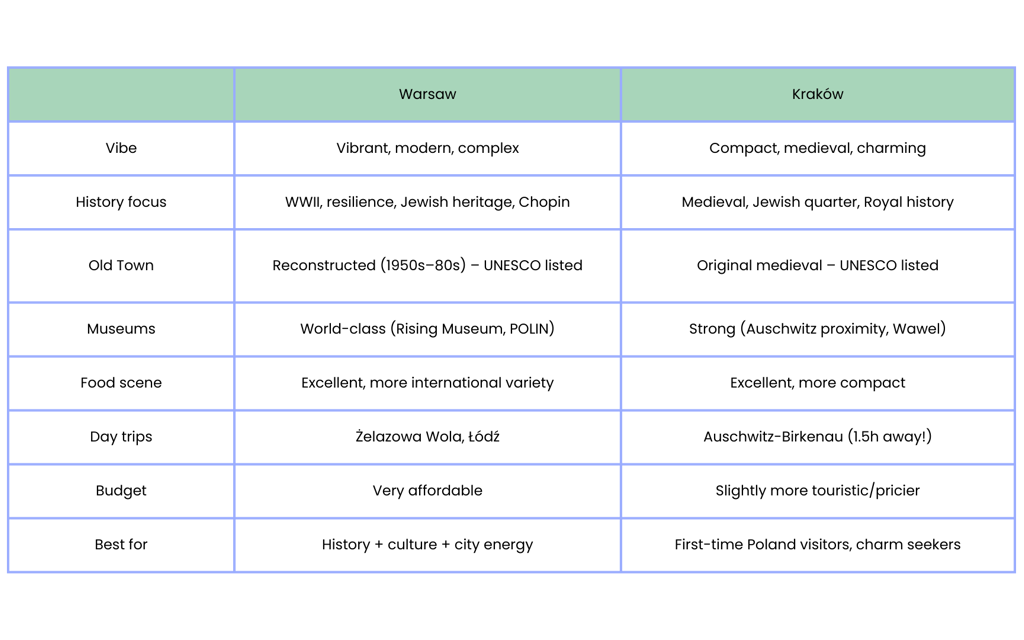
The most common question we get. The honest answer is: both, if you can.
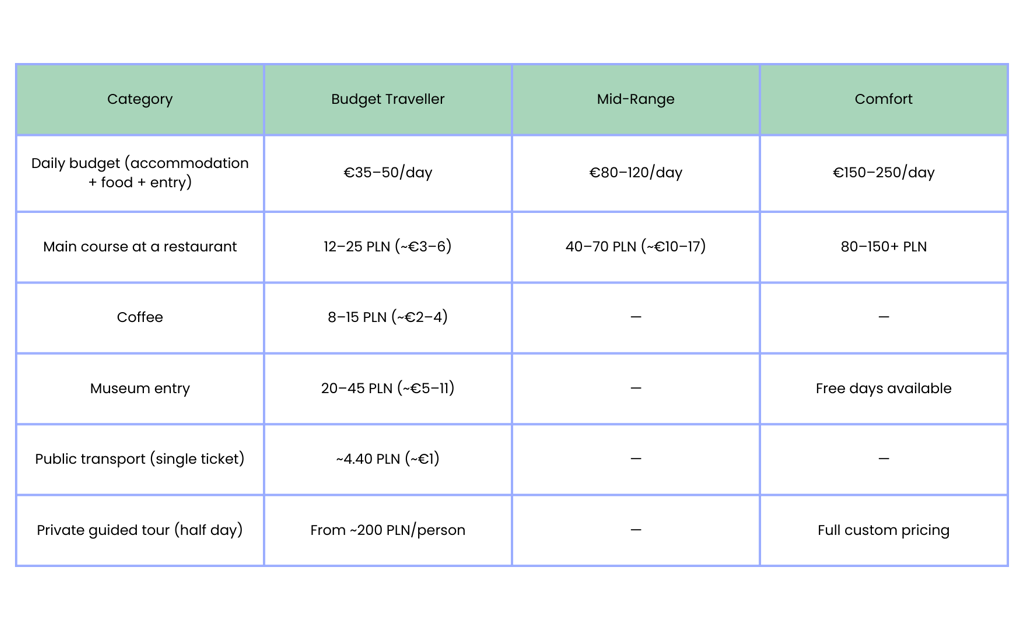
Our recommendation: Spend 2–3 days in Warsaw and 2–3 days in Kraków on the same trip. The fast train between them takes about 2.5 hours. They complement each other perfectly – Warsaw gives you depth and complexity; Kraków gives you beauty and a natural base for Auschwitz.
Is Warsaw Expensive to Visit?
No – Warsaw is one of the most affordable European capitals for tourists. The local currency (Polish złoty, PLN) means your euros or dollars go significantly further than in Western Europe.
Key budget facts for 2025:
Budget accommodation (hostel/budget hotel): from €20–40/night
Mid-range hotel (central): €60–120/night
Lunch at a local restaurant: €5–12
Dinner for two with wine: €30–60 at a mid-range restaurant
24-hour public transport ticket: ~15 PLN (~€3.50)
Warsaw Rising Museum entry: 30 PLN (~€7)
POLIN Museum entry: 35 PLN (~€8.50), with free entry on Thursdays
The main exceptions to Warsaw's affordability are accommodation during major events (like Eurovision or major conferences) and tourist-facing restaurants directly on the Old Town Market Square – avoid these and eat where locals eat.
How Many Days Should You Spend in Warsaw?
2 Days – The Essential Warsaw
Day 1: Old Town + Royal Route – Start at Castle Square, explore the Royal Castle and Old Town Market Square, walk south along the Royal Route past the Presidential Palace and churches to Łazienki Park. Evening: dinner in Śródmieście.
Day 2: History and depth – Warsaw Rising Museum in the morning (arrive when it opens). POLIN Museum and Ghetto area in the afternoon. End with a walk through Muranów neighbourhood to feel the layers of history underfoot.
3 Days – Add Praga and Chopin
Day 3: Take the metro or tram to Praga – explore the pre-war streets, visit the Neon Museum, have lunch at one of the independent restaurants. If it's Sunday in summer, catch the free Chopin concert in Łazienki Park.
4–5 Days – Day Trip to Auschwitz or Żelazowa Wola
With more time, consider a day trip to Auschwitz (see our full guide) or a half-day trip to Żelazowa Wola (Chopin's birthplace, 46 km from Warsaw). Both are easily done from Warsaw.
What Is the Best Month to Visit Warsaw?

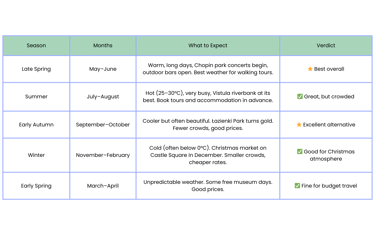
The Chopin open-air concerts in Łazienki Park (every Sunday, May–September, free entry) are one of Warsaw's truly special experiences and worth timing your visit around.
Is Warsaw Safe for Tourists?
Warsaw is a very safe city by European standards. Violent crime targeting tourists is rare. The most common issues are standard European pickpocket situations (Old Town, busy metro stations, crowded trams) – use the same common sense you would in any major city.
Public transport is safe at all hours
Old Town and central districts are well-lit and well-patrolled
Praga (often described as 'edgy') is safe for tourists but use normal awareness at night
English is widely spoken in tourist areas, hotels, and by younger people across the city
Frequently Asked Questions About Visiting Warsaw
Why is Warsaw underrated?
Warsaw sits in Kraków's shadow in most travel itineraries – partly because Kraków's medieval architecture is more immediately photogenic, and partly because Warsaw's WWII devastation means it lacks the 'old European city' aesthetic many travellers seek. Those who come without these expectations are usually surprised by its depth, energy, and emotional power.
Is Warsaw Old Town worth visiting?
Yes – but understand what it is. Warsaw's Old Town was rebuilt almost entirely after WWII, finished in the 1980s based on historical records and the 18th-century paintings of Bernardo Bellotto. It's beautiful, UNESCO-listed, and deeply meaningful precisely because of that reconstruction story. Don't expect Prague's organically aged streets – expect something different and arguably more significant.
Is Warsaw bigger than Kraków?
Significantly. Warsaw has a population of about 1.8 million (with greater metro area around 3 million). Kraków has around 800,000. Warsaw is a proper European capital city; Kraków is a compact university city. Warsaw takes more time to navigate and has more variety; Kraków is easier to cover on foot in a shorter visit.
Do they speak English in Warsaw?
Yes, widely – especially among younger people, in hotels, restaurants, tourist sites, and shops in central areas. Older Poles may speak German or Russian rather than English. In tourist areas you'll have no problem whatsoever.
Is Warsaw worth visiting in winter?
Yes, particularly in December when the Old Town Christmas market is running and Castle Square has a large Christmas tree. The cold (often -5°C to -10°C) is manageable with appropriate clothing, crowds are much thinner, accommodation is cheaper, and the city's indoor offerings – museums, restaurants, Chopin concerts – are excellent year-round.
The Best Way to Experience Warsaw
Reading about Warsaw's history is one thing. Walking through the places where it happened, with someone who can tell you the stories behind every street and building, is something else entirely.
Our private tour guides in Warsaw are certified local experts who grew up in this city. A private walking tour with TellMeMore Travel covers the Old Town, the Ghetto area, key WWII sites, and the stories that give Warsaw its extraordinary character – tailored entirely to your interests and pace.
Warsaw is worth visiting. We're here to make sure you don't miss what makes it truly remarkable.
Contact
Contact us via email:
Subscribe to our newsletter!
office@tellmemoretravel.com
© 2025. All rights reserved.